


The UX Hierarchy of Needs
What a 1943 theory of human motivation still has to teach us about building products people can’t live without.
By Alyssa Skinner · December 2025 · 9 min read
When Maslow Walked Into a Design Sprint
I have a confession: I spend more time reading psychology papers than I do reading design blogs. There’s something about the study of why humans do what they do – how we assign meaning, form habits, feel belonging – that I find far more useful at the whiteboard than another case study on button radius.
So when a psychologist friend and I got into one of those dinnertime rabbit holes about Maslow’s Hierarchy of Needs, I found myself reaching for a napkin. Not because I was hungry. Because I needed to sketch something.
Maslow proposed that human motivation operates in layers. We don’t chase self-actualization when we’re hungry. We don’t seek belonging when we don’t feel safe. The hierarchy isn’t rigid — people move fluidly through it — but the underlying idea holds: unmet foundational needs crowd out everything above them. And as I sketched, I realized that’s exactly how user experience works too.
“Users don’t experience your product as a feature list. They experience it as a feeling. And that feeling has a structure.”
What follows is my take on a UX Hierarchy of Needs – five layers that separate products people tolerate from products that become part of who they are. This isn’t a prescription. It’s a lens. And if you’re wired like me, it might change how you think about the next thing you ship.
The Hierarchy at a Glance
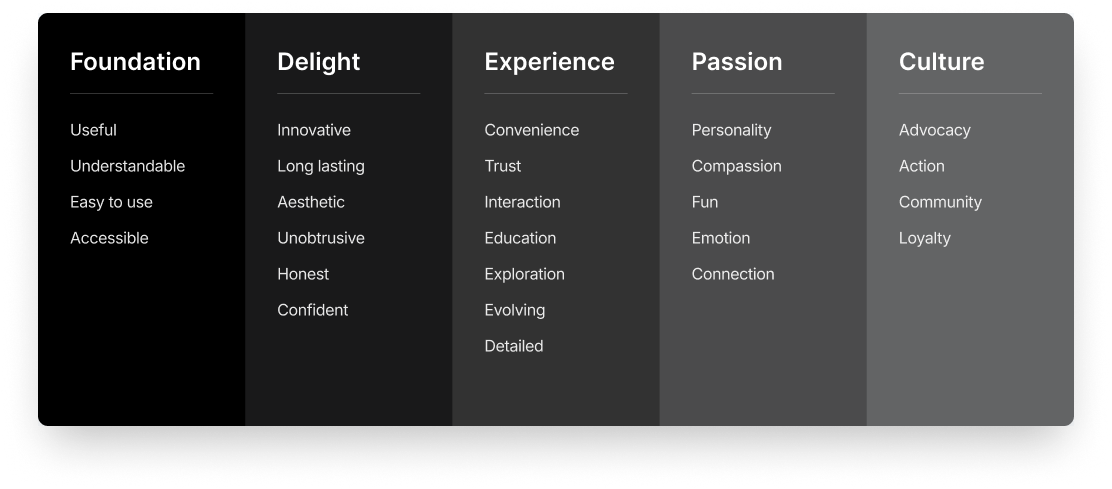
Before we go layer by layer, here’s the shape of it: Usability → Delight → Experience → Passion → Culture. Each layer depends on the one below it. A product that skips the foundation in pursuit of the capstone collapses. And a product that stops at the foundation is forgotten the moment something marginally better comes along.
The most interesting design work happens in the messy middle — the transition zones where a product stops being useful and starts being meaningful. That’s where psychology lives.
Layer 1. Usability – The Baseline We Always Underestimate
Maslow’s physiological needs are non-negotiable. You cannot think about belonging when you’re starving. The same is true in UX: you cannot build loyalty on top of friction.
Usability is the layer most teams claim to nail and fewest actually do. It’s not glamorous. It doesn’t make it into the launch press release. But it is, without question, the layer that kills products when it fails. The door that makes you wonder whether to push or pull. The checkout flow with one field too many. The onboarding that assumes you already understand the product.
Psychologically, what’s happening here is cognitive load management. The brain has a finite budget for effortful processing. Every moment of friction — every confusing label, every unexpected behavior — draws from that budget. When the budget runs dry, users don’t try harder. They leave.
→ Ask yourself: Can a new user accomplish their primary goal in under 3 minutes without help?
→ Ask yourself: Does every interaction behave consistently and predictably?
→ Ask yourself: Have we tested with people who are nothing like us?
Foundational usability means: clear navigation, accessible design, reliable performance, and zero tolerance for ambiguity in critical flows. It is the least exciting layer and the one that deserves the most rigorous attention.
Layer 2. Delight – The Layer That Makes People Smile (and Come Back)
Once the basics are handled, something interesting becomes possible: joy. This is where design stops being plumbing and starts being craft.
In Maslow’s model, this maps loosely to safety needs — the comfort of knowing things will go well, the predictability that creates trust. In UX, delight does something similar: it signals to users that someone cared. That there’s a human on the other side of this interface who thought about them.
Psychologically, we’re in the territory of operant conditioning and emotional memory. Moments of unexpected pleasure — a perfect micro-animation, a witty empty state, a loading message that made you smile — release small hits of dopamine. They become anchors. Users remember how your product made them feel long after they’ve forgotten what they did with it.
Slack’s whimsical loading messages. Duolingo’s passive-aggressive streak notifications. Monzo’s instant spending notifications that feel like a text from a friend, not a bank. These aren’t accidents. They’re designed emotional cues, calibrated to build a specific kind of relationship.
“Delight isn’t decoration. It’s the product’s personality — and personality is what drives word of mouth.”
The trap at this layer is mistaking noise for signal. Not every interaction needs a flourish. Delight works because it’s unexpected. Design teams that over-index here produce products that feel exhausting. The goal is selective magic, not a constant carnival.
Layer 3. Experience – When the Product Starts to Know You
This is where things get genuinely interesting from a psychology standpoint, and where most products plateau.
Maslow’s belonging needs are about feeling seen — by other people, by communities, by something larger than yourself. In UX terms, engagement is the moment a product stops feeling like a tool you’re using and starts feeling like a tool that’s working with you.
The psychological mechanism here is self-determination theory, developed by researchers Deci and Ryan. People sustain engagement when they feel three things: autonomy (I’m in control), competence (I’m getting better at this), and relatedness (this connects me to something or someone). Products that are engineered for all three create what Csikszentmihalyi called flow – that frictionless state where time disappears and action feels effortless.
Spotify’s Discover Weekly works not just because the algorithm is good, but because it makes you feel understood. Notion works not just because it’s flexible, but because that flexibility creates a sense of ownership — your workspace, your system, your logic. The product becomes a canvas for identity.
→ Design for: Anticipation — the product should occasionally surprise users with what it knows about their needs
→ Design for: Progress — users should feel they’re getting better at something, not just doing the same thing
→ Design for: Connection — to other users, to a mission, or to their own evolving goals
At this layer, the product earns regular, voluntary use. Not because users have to. Because they want to.
Layer 4. Passion – The Layer Where Users Become Advocates
This is Maslow’s esteem layer — the need to be seen as competent, to belong to something worth belonging to, to have your identity reflected with respect. Products that reach this layer don’t just satisfy users. They become part of who users are.
The psychology here is social identity theory, first articulated by Henri Tajfel. We don’t just have individual identities; we have group identities. And when a product becomes a signal of belonging to a valued group, it stops being a consumer choice and starts being a statement.
This is why Notion users put ‘I build in Notion’ in their bios. Why Arc browser devotees proselytize with the fervor of early adopters who’ve found their people. Why Nintendo fans don’t just play games – they write fan fiction, attend conventions, and build replicas. The product has become an expression of self.
“You know you’ve reached the passion layer when users start defending your product in arguments they didn’t start.”
From a design standpoint, you don’t manufacture this. But you can create the conditions for it: community features that reward contribution, aesthetic coherence that becomes a badge, a brand voice so distinct it attracts like-minded people and repels those who don’t get it. Passion-level products have a point of view, and they’re not apologetic about it.
Layer 5. Cultural Integration – When the Product Becomes a Verb
And then there’s the capstone. The rarest air in product design. Maslow called this self-actualization — the fulfillment of potential, the point where the individual becomes more fully themselves. For products, it’s the moment they transcend category and become infrastructure.
You don’t use Google, you Google. You don’t edit photos, you Photoshop. You don’t message, you Slack. The product’s logic becomes shared cultural shorthand. A reference point that needs no explanation because it’s woven into how we talk, think, and organize our days.
Culturally integrated products don’t just respond to behavior – they reshape it. The iPhone didn’t give us better phones. It gave us new social norms: constant reachability, the selfie, the swipe. Airbnb didn’t give us better hotels. It gave us a new relationship to strangers’ homes and a new verb – ‘Airbnb it’ – for a category that barely existed.
What’s worth noting, psychologically, this layer creates both connection and dependency. Products at this stage become invisible, which is their power and their risk. We don’t notice the water until the tap runs dry. As designers, that invisibility is the ultimate compliment and the ultimate responsibility.
Why This Framework Matters Now
We’re designing in an era of relentless feature parity. Most product categories now have five to ten competent options. Competence alone, even delightful competence, is table stakes. The products that will define the next decade are the ones that are building toward the upper layers of this hierarchy with intention.
That means hiring for psychology alongside craft. It means user research that goes deeper than task completion, into identity, aspiration, and belonging. It means having the courage to build a product with a personality strong enough to repel the wrong users, so it can deeply attract the right ones.
It means occasionally ditching the roadmap and asking a stranger why they love what they love because that answer is rarely about features.
“The best design work I’ve ever done started not with a brief, but with a question: what does this product make people feel like?”
The UX Hierarchy of Needs isn’t a checklist. It’s a reminder that behind every click is a human being navigating their own version of Maslow’s pyramid – trying to feel capable, connected, seen. Our job, if we take it seriously, is to meet them there.
I’d love to know where you think your product sits on this hierarchy – and which layer feels most out of reach. Drop your thoughts below, or find me where designers argue about this stuff on the internet.
About the Author
Alyssa Skinner – A Senior Product Designer with a habit of reading psychology papers before design blogs. Passionate about the invisible architecture of human behavior and how it shows up in the products people love. Previously at several Fortune 500 technology companies.